
 Français
 Deutsch
 Italiano
 Español
Shopping Cart
Sport and postpartum: Isabeau Courdurier on her return to the top of enduro
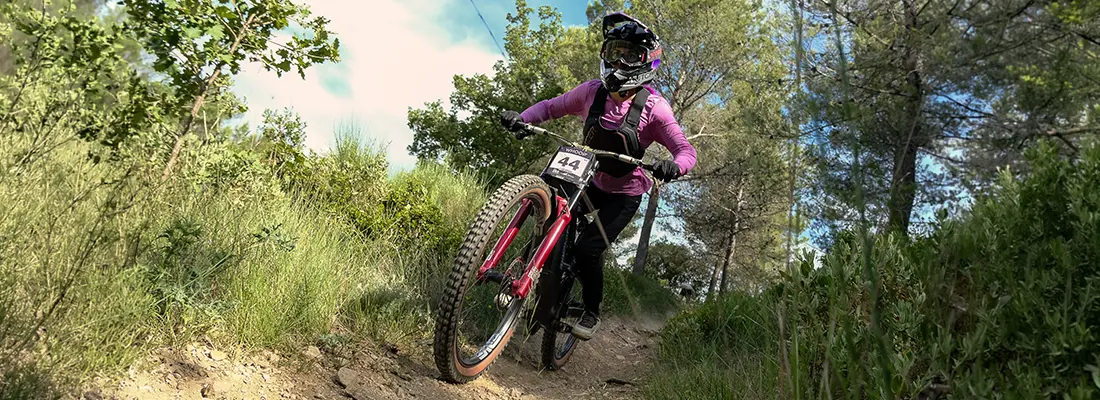
October 2026, Finale Ligure. On the final stage of the Enduro World Championships, Isabeau Courdurier sets the fastest time and takes the silver medal, just over a second and a half off the title. Between her 2024 world title and this podium came a break: a pregnancy and the birth of her son.
Returning to sport after giving birth often raises the same questions: when to start again? At what pace? And how to regain confidence in your body? For an enduro mountain bike racer who hurtles down slopes at full speed, these questions take on another dimension.
As a RACER 1927 ambassador, Isabeau agreed to tell us about her return to sport after childbirth, unfiltered. Her answers will resonate with every sportswoman going through this moment, from elite level to leisure. We share them just as she gave them to us.
“Being one of the first athletes in this field to return to the highest level after becoming a mum gives meaning to my journey.”
6 months
between the birth of her son and her first race
15+
race weekends in a row this season with her son
≈ 1.5 s
off the world enduro title at Finale Ligure
1. Returning to sport after childbirth: Isabeau’s timeline
No rushed comeback, no miracle plan. Isabeau’s return was built step by step, starting with a genuine break. Here are the key milestones of her comeback.
Milestones of her return to training
- End of 2024Complete break from sport for two to three months, after her world championship title.
- During pregnancyOccasional training, by feel, with no plan.
- 1 month after the birthVery light return to strength training, to rebuild a solid core.
- 2 months afterBack on the road bike, gently.
- 6 months afterFirst race, a regional downhill in Blausasc.
- A few weeks laterThe World Cup at Loudenvielle.
You recently returned to the top level with your enduro world vice-champion title this month. How long did you stop training completely?
I stopped training for only a few months, at the end of 2024, when I finished my season after my world championship title.
I really wanted to rest and take a big break. So I did no sport at all for two to three months. I needed to recover before thinking about what came next and trying to get pregnant.
After that, I carried on training now and then, by feel. Without following a training plan, even during my pregnancy.
I resumed training one month after my son was born, but very gradually and gently.
How much time passed between giving birth, your return to training and your first competition as a mum?
One month after his birth, I went back to strength training, very lightly at first, to gradually rebuild a solid core. Then, after two months, I got back on the road bike, again very gently.
My first competition came six months after his birth. It was a regional downhill (DH) race in Blausasc. A few weeks later, I lined up for the downhill World Cup round at Loudenvielle.
How did you decide on the timing of this return? Was it a matter of instinct, the sporting calendar or medical advice?
It was a combination of all these factors.
First I listened to medical advice and followed all the guidance on rehabilitation and postpartum follow-up. Then I relied on my instinct: did I feel ready to start again? How did I feel?
I really tried to respect those feelings throughout my comeback, taking the time to go through each stage of the process.
Finally, of course, the sporting calendar was also becoming clearer. We had planned the Loudenvielle downhill World Cup as the first big competition target.
Looking back, would you make this comeback at the same pace?
Yes and no.
I think I would probably do the very first months after my pregnancy the same way. However, with a bit of hindsight, I might have entered fewer competitions in my first year back.
This year, I strung together more than fifteen race weekends with my son. That was maybe a bit too much for a comeback year.
With hindsight, I would therefore be more selective about the competitions I enter, so as to manage my energy better and find a more sustainable balance between my sporting career and my life as a mum.
“First I listened to medical advice. Then I relied on my instinct.”
2. Fatigue, sensations, fear: what the postpartum period changes in the body and mind of an elite athlete
We often imagine the hardest part is regaining physical fitness. For Isabeau, the real challenges lay elsewhere: a new kind of fatigue, riding reflexes to rebuild and a relationship with risk to reinvent.
Were there any difficulties you did not expect at all when returning to the top level after your pregnancy?
I think I had anticipated as much as possible about my pregnancy and the period after it.
The main difficulties I faced were really linked to fatigue: learning to manage this new fatigue, but also dealing with fear when returning to competition with this new status as a mum. It’s a new responsibility, one you’re not used to, and one you have to learn to build into your daily life.
I’d say those were the two biggest difficulties I had to face.
Physically, how did the return to training go? What was hardest to get back?
Physically, the hardest thing was getting back my sensations on the bike, my riding, and above all feeling comfortable again as speed increases.
I think that’s really what takes the most time. When you haven’t ridden very fast for a while, you lose certain reflexes, particularly the ability to quickly read the terrain and make decisions about lines and trajectories.
So you have to rebuild that speed of analysis and decision-making, which is essential when riding at a high level.
Psychologically, what changes did you feel? Has your relationship with risk evolved? Did you need support for this return?
Psychologically, what was new for me was mainly learning to manage my relationship with risk.
At first I was a little afraid of how I would react with this new responsibility as a mum. But very quickly I realised that when I’m on my bike, at full speed on the descents, I’m so focused, in my bubble and in my zone, that I don’t necessarily think about all that. In the end, it hasn’t really changed my relationship with speed.
However, my approach to risk-taking has changed a lot. Today I think more before taking a risk and I no longer take unnecessary ones. For example, I no longer launch into a line of jumps or a technical section without having scouted it beforehand.
“Today I think more before taking a risk and I no longer take unnecessary risks.”
I’m now more about preparation, analysis and execution. I place much more importance on that upstream phase, whereas I might have been more spontaneous before.
I also kept working with my mental coach, with whom I’ve collaborated for several years. For this comeback, the work focused mainly on how to return to competition feeling sure of myself, confident and comfortable with this new status as a mum.
I also struggled a bit to find my place again in this world after the break. So I had to work on that aspect to gradually regain my confidence and feel fully at home again as an athlete.
3. Woman, mum and racer: making your place in enduro mountain biking
Enduro mountain biking remains a predominantly male world. But the lines are shifting, on the podiums as well as at Sunday races. And Isabeau’s comeback sends a strong message to all those torn between motherhood and a sporting career.
Enduro mountain biking is a fairly male-dominated world. Have you seen change since the start of your career?
Mountain biking in general remains a fairly male-dominated world. However, I’ve seen real change since the start of my career, particularly in the number of women who take part in competitions and take up enduro mountain biking.
Day to day, this translates into better visibility for women’s sport, but also a greater presence of women at races, especially at local and regional events in France.
Do you feel a difference in treatment or in how you are seen as a female athlete and now an athlete and mum in this world?
I don’t particularly feel any difference in treatment or in how I’m seen since becoming a mum. On the contrary, I feel real kindness and I receive a huge amount of encouragement.
I think being one of the first athletes in this world to return to the highest level after becoming a mum gives meaning to my journey. It also helps show that it’s possible and opens the way for other women who might be asking themselves questions about the compatibility of motherhood and a sporting career.
“Showing that it’s possible and opening the way for other women.”
So I really get very positive feedback and many kind messages, which is very encouraging.
4. Performance and motherhood: the start line as a victory
Did becoming a mother change the champion? Not really in racing, Isabeau tells us. But the way she looks at performance has broadened. This is perhaps the most inspiring part of this interview.
Has your definition of performance changed since you became a mum?
My definition of performance hasn’t really changed since I became a mum. I’ve always wanted to ride mountain bikes to improve, to be a better version of myself and a better athlete, even before trying to win medals. And that hasn’t changed with motherhood.
However, today performance is no longer just about the result. It encompasses the whole process you put in place to get there: the preparation, the work put in and all the steps that allow us to reach our goals.
I’d also say that what has changed is that I now consider simply being on a start line, and having the commitment to go for it, as a performance in itself.
“I now consider simply being on a start line, and having the commitment to go for it, as a performance in itself.”
Did becoming a mother make you different in racing? Has your relationship with competition and risk-taking changed?
Becoming a mother hasn’t made me different in racing compared with before. However, I no longer really see competition as an end in itself.
Today, having the chance to compete while being a mum has almost become a bonus. It’s a part of my career that I appreciate all the more, because I realise how lucky I am to be able to keep living this sporting adventure while building my family life.
Has motherhood taught you something that elite sport had not taught you?
Motherhood taught me to be truly in the present moment, not to anticipate too much, and to accept that things don’t necessarily go as planned.
With a child, you constantly have to adapt and listen to yourself, to your surroundings and to your child.
I’d say it taught me to be much more open to last-minute changes, to accept not being in control of everything and to adapt to situations as they come.
5. Training, competitions and life as a mum: a team effort
More than fifteen race weekends in a single season, with a baby in tow. Behind this invisible feat lies well-oiled logistics and a close-knit team. Isabeau takes us behind the scenes of her daily life.
How do you balance training, competition, travel and life as a mum?
I’m lucky to be very, very well supported, particularly by my husband and my mother, who come with me when I travel.
Thanks to them, I manage to organise my daily life and my travel to competitions. It’s quite a logistical feat and it takes an enormous amount of organisation. But after a first season, we found our bearings and today we are able to handle it all much more calmly.
Do you have a precise weekly routine? If so, what is it?
I have a fairly precise weekly training routine. My son goes to daycare three days a week, which lets me schedule days with two training sessions.
The rest of the time, my daily life revolves around work, training and family life. For all this to work, you need a well-oiled organisation and you have to accept making certain sacrifices.
My husband and my family are very present to help me and make this daily life possible. On the sporting side, I’m also supported by a sports coach and a mental coach, who help me structure my training and progress.
It’s truly teamwork: without this support network, it would be much harder to balance all these aspects of my life.
What view would you like your son to have of your job as an athlete? Would you like him to follow an elite sporting path, or are you afraid of seeing him take part in a risky sport like yours?
Above all I would like my son to understand that it is possible to make your passion your job. I’d like him to have that chance too, if he wants it later on.
I don’t necessarily wish for him to follow an elite sporting path. However, if that is his choice, I will do everything in my power to support him on that road. What matters most to me is that he is fully fulfilled in whatever he undertakes.
I think playing sport is very important for building yourself in life. It teaches us a great deal, well beyond performance.
As for the choice of sport, if he ever decides to take up a risky discipline, I will put all my experience at his service to support him and make sure he can progress in the best possible conditions, limiting the risks as much as possible.
Because in our sport, preparation plays an essential role in preventing injuries. You can never completely eliminate risk, but you can learn to understand it better, anticipate it and prepare for it.
“You can never completely eliminate risk, but you can learn to understand it better, anticipate it and prepare for it.”
Returning to sport after pregnancy: what we take away from Isabeau’s journey
Isabeau Courdurier’s comeback is no miracle. It is the fruit of a deliberate break, a gradual return and a solid support network. A few valuable lessons stand out, whether you race World Cups or ride your weekend trails:
Key takeaways
- Listen first to the medical profession, then to your own sensations. Every pregnancy is different: postpartum rehabilitation and the advice of your midwife or doctor remain the starting point.
- Progress in stages: strengthening and core work first, then the bike, then intensity.
- Give your sensations time: riding skills and terrain reading come back with rides, not in a day.
- Prepare rather than improvise: scouting a section before committing to it means riding with more peace of mind.
Gear up to ride with a free mind
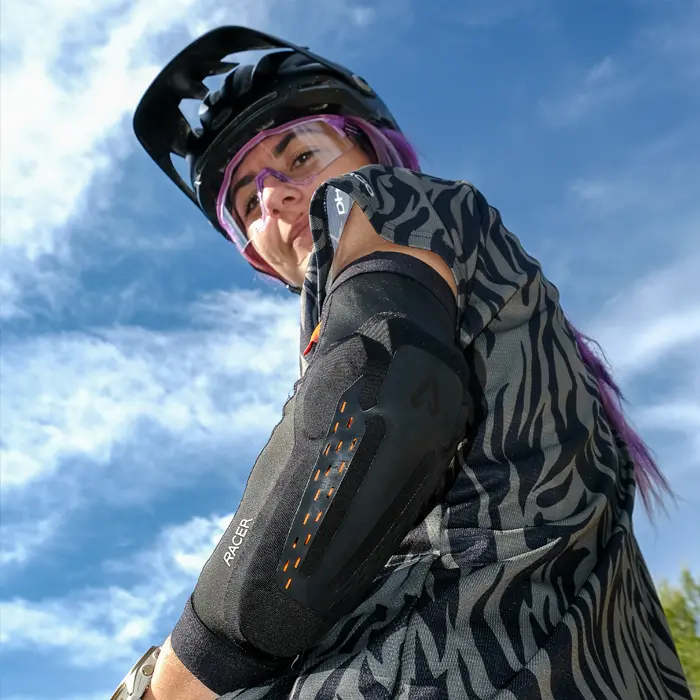
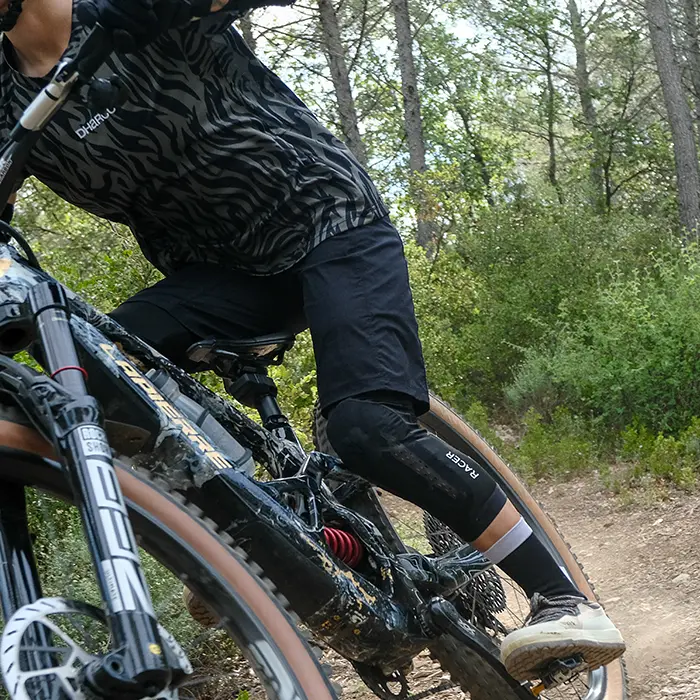
As Isabeau reminds us, you never completely eliminate risk, but you can prepare for it. That preparation also involves equipment. Knee pads, elbow pads, protective vests: discover the RACER 1927 mountain bike protection, designed to support you on downhill and enduro rides alike.
And to follow the rest of Isabeau’s season, head over to our social media, and hers!